
Repetitive work does not just cost hours. It costs capacity.
These four are from real engagements. If one of them sounds like your own back office, that is the conversation to have — the impact is measurable in hours and in money, and we measure it before we quote.
A wholesaler's back office entered orders and attendance by hand, line by line. Every entry was work nobody needed to do and a chance to get a digit wrong.
A machine shop created 15 to 25 assemblies — 70 to 120 Helios items — every week from drawings, applying the same standards each time.
Sales searched K2 and Excel for the right combination of dimension, material and colour, quoting from data that might already be stale.
Contract approvals ran through email with no audit trail, so nobody could show afterwards who had reviewed which version.
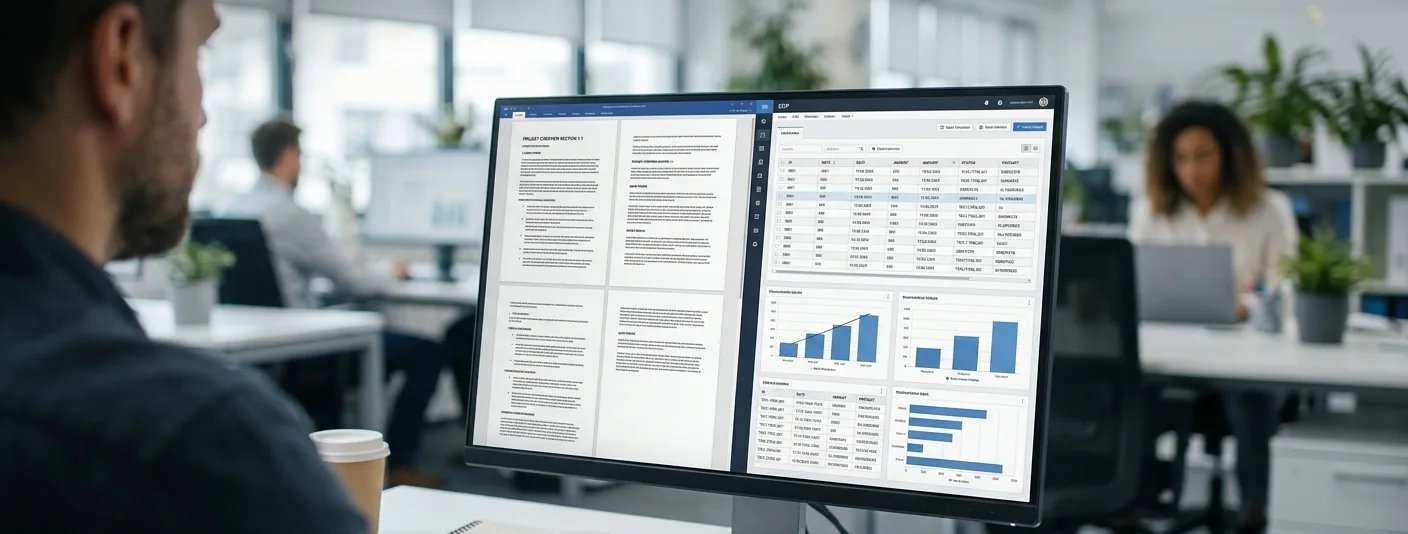 This is what all four look like from behind.
A document on one side of the screen, the system it has to reach on the other, and a person in between doing the reaching. Automation removes the middle step, not the person.
Five kinds of bottleneck, and they are usually not the ones people name first.
Most companies ask us about the transactional layer because it is the visible one. The knowledge and monitoring layers are where the quieter money is.
Pull attachments apart, sync CRM and ERP, create records, generate quotes — including the whole email-to-order path.
Ask a question across PDFs, spreadsheets and drawings in plain language and get the answer with the source attached.
ERP and warehouse data assembled into one view without somebody rebuilding it by hand every Monday.
Recurring web, email and WhatsApp traffic handled around the clock, with only the exceptions escalated.
Catch a slipping date or an out-of-range value early, and leave the decision about it to a person.
Each phase ends where you could walk away.
The order is deliberate. We spend the first two weeks finding out whether this is worth doing at all, and we have told clients it is not.
We map inputs, handoffs and duplicated work, then set a baseline for time, cost and quality. Without that number, nobody can tell in month nine whether it worked.
A live prototype runs against your actual documents. On one machine-shop engagement we audited five to ten real drawings before quoting, because the layout of a title block changes both the reliability and the price.
Existing systems, data, approvals and decision points wired together so the thing becomes part of the working day rather than a tool somebody has to remember to open.
We operate and keep improving it after launch. One K2 engagement ran with two years of hosting and a source-code buyout option written in from the start.
Knowing what not to automate is most of the skill.
Reliability comes from the line, not from the coverage. Four places where we deliberately leave the work with a person.
On complex drawings, OCR reads the title block and the bill of materials — the fields that are dependable. Ambiguous dimensions are not read at all, because a wrong dimension costs more than the minute it saves.
An engineer enters sheet thickness or bend count in a short dialog; the verified figure then builds the ERP structure. The machine does the typing, the human does the seeing.
A contract workflow logs who reviewed what and when, and produces the audit trail. The signature itself stays human, every time.
The monitoring layer raises a deviation. What happens next is somebody's call, and that somebody has a name in the design document.
 And one that is about us, not the software
Realism is part of the contract.
And one that is about us, not the software
Realism is part of the contract.
Plans account for ERP data arriving late, for holidays, and for the client-side dependencies that always exist. We would rather quote a date we can hold than the date that wins the meeting.
A machine shop, and the agent that stopped the retyping.
The clearest way to explain how we work is to show one engagement in order, including the week we spent finding out whether it was possible at all.
One process engineer manually created 15 to 25 assemblies — 70 to 120 Helios items — each week from PDF, DWG and DXF files, applying the same standards every time.
Title-block layout decides what can be read reliably, and therefore what the work costs. We would rather spend a week finding that out than quote a number we would have to revise.
The agent reads title blocks and parts lists, finds similar existing items, and builds the component structure with process steps and time standards attached.
Dimensions that need judgment were left with the process engineer on purpose. The rollout was staged rather than switched on, so each step could be checked against the old way before the next one started.
Where a fixed track is not enough and the work needs judgment.
How we build agents →Your systems, security in the design, and a number at the end.
K2, Helios, Business Central, SharePoint, Microsoft 365, your accounting package, PDM and CAD, email and WhatsApp — connected through whichever orchestration layer your own people will be able to maintain.
Encrypted data, GDPR controls, an on-premises option, and stated rules for AI use. That is what makes regulated and sensitive work possible rather than a special case.
Time, transaction cost, quality, errors and capacity, measured against the baseline from phase one. Typical payback is 3 to 12 months.